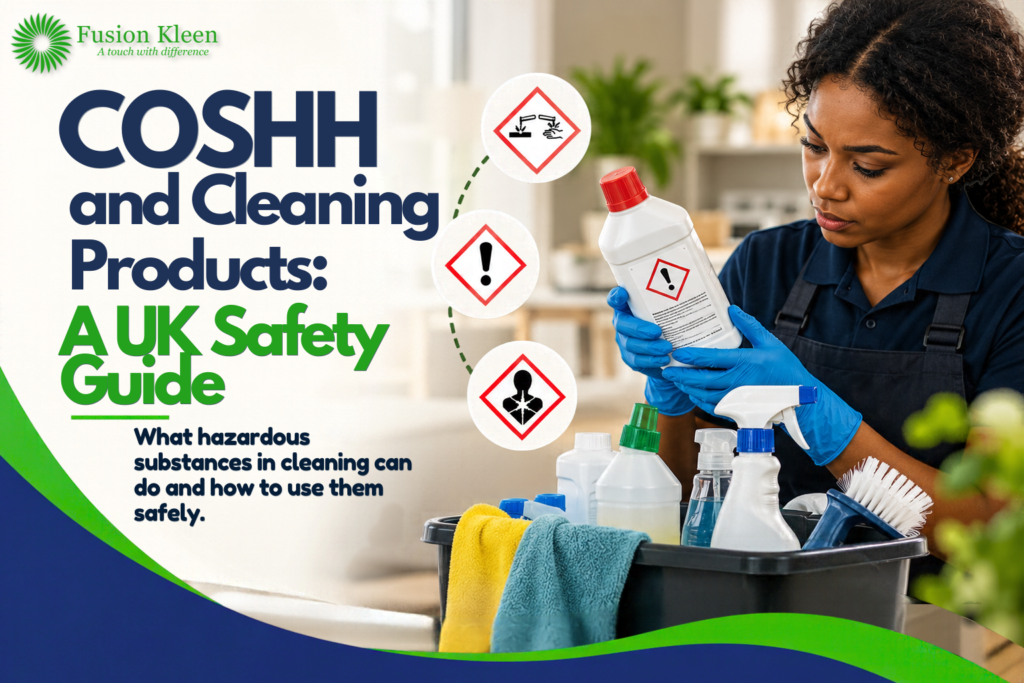
COSHH and Cleaning Products: What UK Households and Businesses Should Know
Cleaning products help remove dirt and maintain hygienic spaces, but some substances can irritate skin and eyes, affect breathing or cause harm if used incorrectly.
In UK workplaces, COSHH (Control of Substances Hazardous to Health Regulations) sets requirements for controlling risks from hazardous substances. Cleaning products may be relevant where their ingredients or use create a health risk.
Understanding the basics can help businesses think carefully about safe working practices and help households handle products responsibly.
This article is general information; it is not a substitute for current official guidance or a workplace-specific risk assessment.
1. What Does COSHH Mean?
COSHH is workplace health and safety legislation. Employers must assess relevant risks from hazardous substances and prevent or adequately control exposure. The duties depend on the substance, task and circumstances.
Some cleaning products can cause harm through skin contact, splashes, inhalation or accidental ingestion, while other products may present lower risks when used as directed.
The important point is to identify the actual hazards and the way people may be exposed rather than treating every product as identical.
2. Why Cleaning Products Need Careful Handling
A product that is safe when used as directed may be hazardous if it is sprayed in a poorly ventilated room, mixed with another chemical or used at an incorrect concentration.
Concentrated products can present different risks from ready-to-use versions. Workplace cleaning may also involve repeated exposure over a shift, making good procedures and suitable equipment important.
Read the label and any relevant safety information, and follow the instructions rather than relying on smell, colour or familiarity to judge whether a product is safe.
3. Read Labels and Follow Instructions
Check the product label before use. Pay attention to:
- Dilution instructions.
- Application methods.
- Ventilation requirements.
- Recommended protective equipment.
- First-aid guidance.
Do not transfer a chemical into an unlabelled container, and do not use a product for a purpose that the manufacturer does not recommend.
A stronger mixture is not automatically more effective; it can increase risk, leave residue or damage the surface.
Where a workplace uses a concentrated product, staff should understand how to prepare and apply it safely.
4. Never Mix Cleaning Chemicals
Never mix cleaning products unless the manufacturer explicitly instructs you to do so. Combining products can cause unexpected reactions.
In particular, mixing bleach with acidic products or ammonia-containing products can release dangerous gases.
Use one product at a time, follow the label and ventilate the area as directed.
If an unexpected reaction occurs, move away from the affected area, avoid breathing fumes and seek appropriate emergency guidance rather than attempting to clean up a hazardous mixture without training.
5. Safe Storage and Protective Equipment
Keep products in their original, labelled containers, securely closed and stored as directed. Store them away from food, children, pets and incompatible substances.
Do not leave chemicals in walkways where they could be knocked over.
Gloves, eye protection or other protective equipment may be required depending on the product and task. The choice should be based on the label, safety information and workplace assessment.
Protective equipment is not a substitute for good procedures, ventilation and reducing exposure where possible.
6. What Employers Should Consider Under COSHH
Employers should identify the substances used, understand the hazards, assess how workers may be exposed and put appropriate controls in place.
This may involve:
- Choosing a less hazardous product.
- Improving ventilation.
- Changing the way a task is performed.
- Limiting access to areas where hazardous substances are used.
- Providing suitable protective equipment.
- Giving staff relevant instructions and training.
- Maintaining required assessments and records.
Employers should consult current Health and Safety Executive (HSE) guidance and seek competent advice when they are unsure how the requirements apply to their workplace.
7. Training and Clear Procedures
A short written procedure can help staff understand which product to use, how to dilute it, what protective equipment is needed and what to do if there is a spill or exposure.
Training should match the task rather than relying on staff to work it out independently.
Supervisors should make sure labels remain readable and products are not placed in unsuitable containers.
Review procedures when products, equipment or working conditions change.
8. What About Cleaning at Home?
COSHH is primarily a workplace regulation, but safe handling matters at home too.
Follow product instructions, use suitable ventilation and keep chemicals out of reach of children and pets. Store products securely and avoid mixing them.
If a product contacts skin or eyes, follow the label’s first-aid instructions and seek medical advice when indicated.
If fumes cause breathing difficulty or a serious reaction, leave the area and seek urgent emergency assistance.
9. Choosing a Professional Cleaning Service
If you hire a cleaning company, tell them about any relevant restrictions in your property, such as delicate materials, ventilation concerns or a preference for particular products.
Ask how they will approach sensitive surfaces and confirm any special requirements before the appointment.
A professional service should use products appropriately and consider the task and surface, but you should still communicate your concerns rather than assuming the company knows about them.
Cleaning Services from Fusion Kleen
Fusion Kleen Ltd provides cleaning services for homes and businesses across Hertfordshire, London and Essex.
If you are considering professional cleaning, explore the available services on the Fusion Kleen website and discuss any property-specific requirements before arranging a visit.
Where to Find Authoritative COSHH Guidance
For workplace-specific requirements, consult the UK Health and Safety Executive’s COSHH guidance and its information for cleaning activities.
These official resources explain how to identify hazards, assess risk and control exposure.
Use them alongside product labels and any relevant safety data sheets. A general blog article cannot replace an assessment of your own workplace.
Final Thoughts
Safe cleaning begins with understanding the product, following instructions and avoiding shortcuts.
Businesses should assess their own workplace risks and consult current HSE guidance. Households can also reduce avoidable risks by storing products safely, using them as directed and never mixing chemicals.
Frequently Asked Questions
What does COSHH mean?
COSHH stands for Control of Substances Hazardous to Health. It is a UK workplace health-and-safety framework for assessing and controlling risks from hazardous substances.
Does COSHH apply to cleaning products at home?
COSHH is primarily a workplace regulation, so household use is not treated in the same way as an employer’s workplace duties. However, people at home should still follow product labels and safe-storage instructions.
Can I mix different cleaning products?
No. Never mix cleaning products unless the product instructions explicitly say it is safe. Mixing products, especially bleach with acids or ammonia-containing products, can release dangerous gases.
What should a business do to manage cleaning product risks?
Employers should identify hazardous substances, assess the risks, use suitable controls, provide relevant information and training, and review arrangements when circumstances change. Consult current HSE guidance for workplace-specific requirements.
Where can I find reliable COSHH guidance?
The UK Health and Safety Executive (HSE) publishes guidance on COSHH and cleaning activities. Use current official guidance alongside product labels and relevant safety data sheets.